
It happened, as these things tend to, entirely by accident.
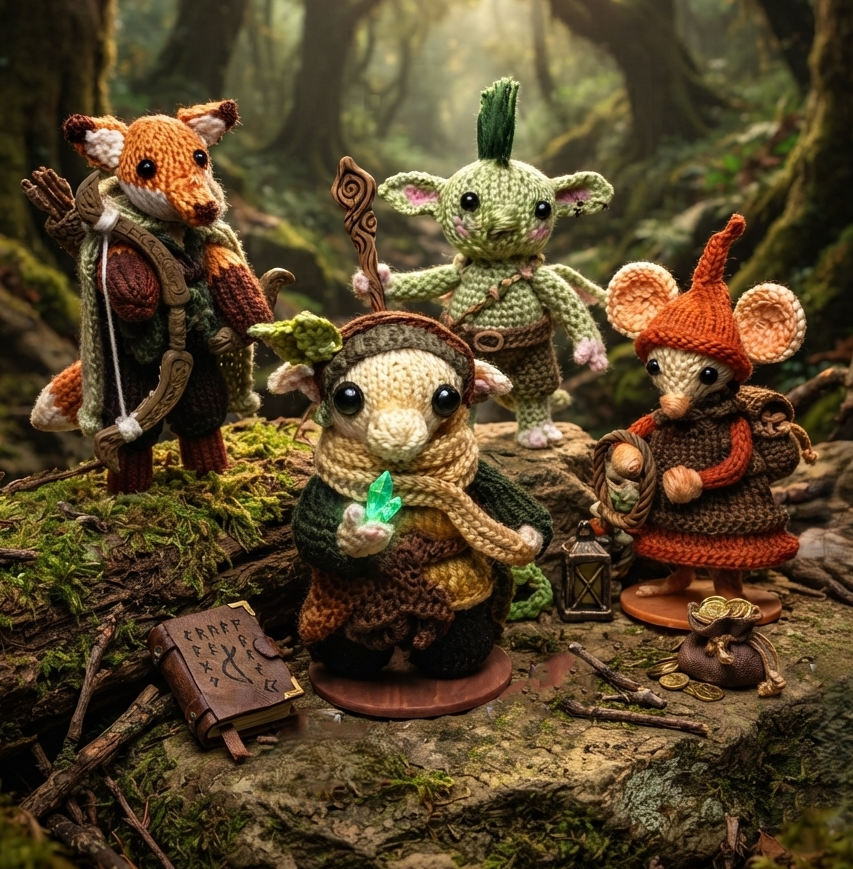
Fern had finally worked up the nerve to pass the third bend in the path — the one she’d been almost-reaching for longer than she’d admit — only to find the way forward already occupied. River was there, leaning against a mossy stump with his bow slung loose, giving directions to no one in particular, the way he did most evenings when there was no one around to actually receive them. A little further on, Puddle had settled into a soft patch of moss with his book propped open, lantern lit against the coming dusk, utterly absorbed. And above them, on a stone ledge just off the path, Moss sat with his arrows within reach, keeping his usual watch over an evening that had never once needed watching.
Four creatures, four good reasons for standing exactly still, all converging on the same stretch of wood at once.
It was Fern who broke the silence, mostly because her coin pouch chose that moment to spill a little across the ground. River bent to help her gather them up, more out of habit than urgency — pointing things out was, after all, what he did — and in doing so nearly stepped on something small and green, half-buried in the moss, catching the lantern light in a way that ordinary stones didn’t.
“That’s not a stone,” said Puddle, not even looking up from his book at first. Then he did look up. Then he set the book down entirely, which — everyone would later agree — was how you knew it was serious.
Moss was down off his ledge before anyone asked him to be, arrows forgotten, already crouched beside it with the particular focus of someone who had been ready for something to happen for a very long time and had finally, finally gotten his wish.
The crystal didn’t do anything dramatic. It didn’t hum or glow brighter or grant a single wish. It just sat there in Puddle’s cupped paws, catching the light, while four creatures who’d each spent a long time standing very still in their own separate corners of the wood found themselves, for once, standing still together.
They didn’t decide to travel as a group so much as fail to leave. Puddle knew a passage in his book that might explain what the stone was, if someone patient enough sat with him to work through the old lettering — and Moss, it turned out, had more patience for that sort of thing than he let on, once he stopped waiting for danger and let himself actually be curious instead. Fern’s basket was, conveniently, exactly the right size to carry it safely, padded with the scarf she’d knit and never quite finished. And River, without really meaning to, found himself pointing the way toward the next village over — not because anyone needed guiding, but because for the first time in a long while, he had somewhere he actually wanted to go.
Their first real adventure was a short one. Two days’ walk to an old hedge-witch who might know what they’d found, Puddle reading aloud from his book the whole way to anyone who’d listen (which, gradually, became everyone), Moss insisting on checking the same three knots in his rope belt every evening whether they needed checking or not, Fern doling out rations from a basket that seemed, impossibly, to hold more than it should. River walked a little ahead, the way he always had, except now there were footsteps behind him instead of just his own — and he found he didn’t mind that nearly as much as he’d have guessed.
The hedge-witch, when they found her, took one look at the stone and laughed — kindly — and told them it wasn’t magic at all, just a very old, very pretty bit of quartz, the kind children used to collect for luck. Not one of them was disappointed. They’d already gotten the better end of the bargain: a fox who’d finally found a direction worth walking, a mouse whose basket finally had somewhere to go, a troll who’d found people willing to sit still and listen, and a goblin who’d finally gotten to be useful for something.
They kept the stone anyway. Not for what it was, but for what it had started.